The History & Evolution of Mad Libs: Humorous Origins and Enduring Legacy
Think about it: when was the last time a simple request for a noun, verb, or adjective led to side-splitting laughter, groans of delight, and perhaps a moment of accidental genius? If you’ve ever filled in the blanks of a story only to discover a “fluffy cow ate my purple spaghetti” or a “wobbly professor danced with the sleepy moon,” then you've experienced the magic of Mad Libs.
It’s more than just a silly game; it’s a cultural touchstone that has delighted generations, woven into the fabric of road trips, slumber parties, and impromptu family gatherings. But how did this seemingly simple concept—filling in the blanks with random words—become an enduring phenomenon that has sold over 100 million copies? The origin story is as wonderfully unexpected as a freshly completed Mad Lib itself.
At a Glance: Your Quick Guide to Mad Libs' Story
- Brainchild of Brilliance: Created in 1958 by TV writers Roger Price and Leonard Stern, born from a moment of writer's block.
- The "Clumsy and Naked" Breakthrough: An absurd suggestion for a character's nose sparked the core idea: combining unexpected words for humor.
- A "Mad" Name: Named after an overheard conversation at Sardi's, blending "ad-lib" with a "mad idea."
- Self-Published Success: After rejections, Price and Stern self-published 14,000 copies, storing them in Price's apartment.
- The Bob Hope Boost: A pivotal appearance on The Steve Allen Show with Bob Hope led to overnight sell-outs.
- Publishing Powerhouse: The trio formed Price Stern Sloan (PSS), becoming a major West Coast publisher.
- Enduring Legacy: Still popular today, praised for fostering creativity, language skills, and pure, unadulterated silliness.
Chapter 1: The Brains Behind the Blank – From Droodles to Delight
Before Mad Libs became a household name, one half of its creative duo, Roger Price, was already a master of playful absurdity. In 1953, Price introduced the world to Droodles—simple, abstract images that were actually humorous picture riddles. Imagine a drawing that looks like "a pig looking into a mirror" or "an early bird who caught a very strong worm." Price, a prolific TV personality in the 1950s, struck gold with Droodles; his book sold a staggering 30,000 copies in its first week, spawned newspaper syndication, and even inspired a TV game show he hosted. Droodles were a significant, albeit fleeting, cultural phenomenon.
It was this inventive spirit, this knack for turning simple concepts into widespread entertainment, that Price brought to his next big idea.
Leonard Stern's Writer's Block Breakthrough
Enter Leonard Stern, a talented writer who found himself in the grip of that most frustrating of creative afflictions: writer's block. The year was 1953, and Stern was wrestling with a script for the iconic TV show The Honeymooners. He needed an adjective to describe a character's nose – a seemingly innocuous detail that had brought his creative flow to a screeching halt.
Frustrated, Stern turned to his friend and collaborator, Roger Price, for help. Price, ever the quick wit, didn't offer a polite, conventional suggestion. Instead, he quipped, "clumsy and naked."
The Spark of Genius: Unlikely Word Combinations
The absurdity of "clumsy and naked" describing a nose instantly broke through Stern's creative wall, dissolving his frustration into laughter. It was a completely unexpected, wildly out-of-place combination of words that, precisely because of its incongruity, was hilarious.
This seemingly trivial moment wasn't just a laugh; it was a lightbulb. Price and Stern recognized the inherent humor in juxtaposing ordinary sentence structures with utterly random, often ridiculous, word choices. They realized that by intentionally divorcing meaning from context, they could create comedy. This insight was the genesis of Mad Libs – a game designed to systematically produce that same kind of unexpected, side-splitting humor. It took a few years to formalize the concept, but the seed was planted in that single, silly suggestion.
Chapter 2: A Mad Idea Gets Its Name and Its Start
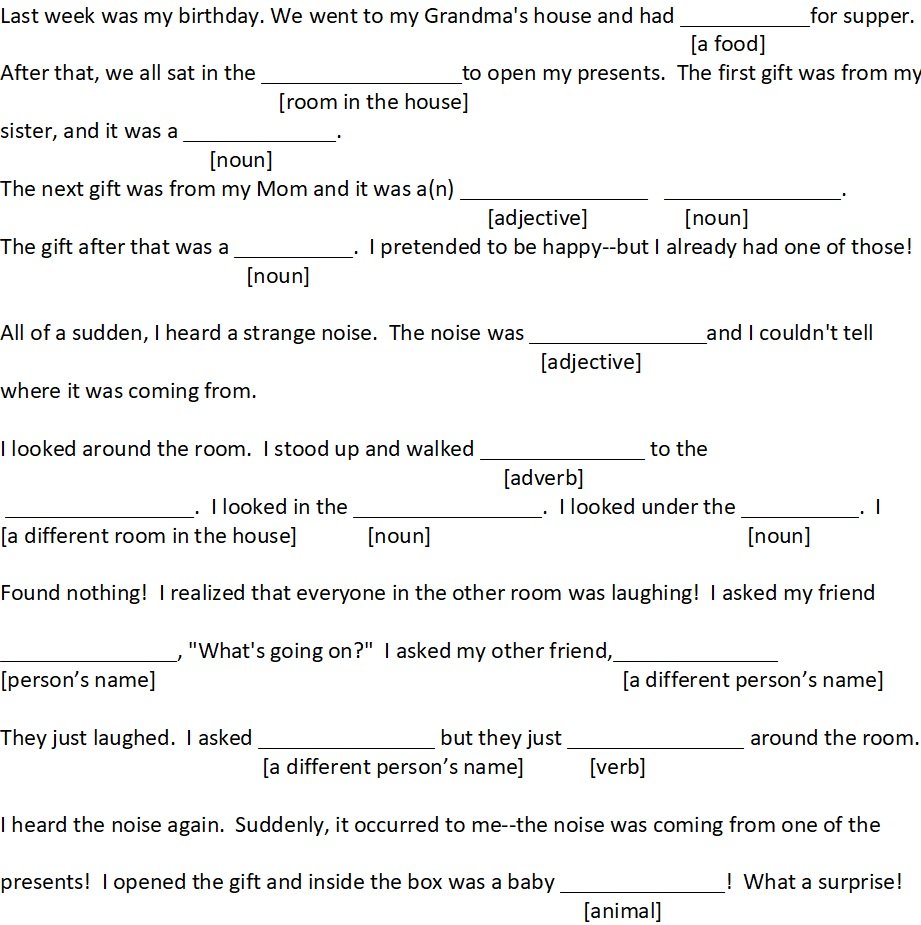
By 1958, Price and Stern had refined their game: a story with key words removed, replaced by blanks indicating the part of speech required. Players would fill in these blanks without knowing the story's context, leading to often uproarious results. But what to call this new brand of wordplay?
Sardi's and a "Mad" Ad-Lib
The name "Mad Libs" itself is a story worthy of its creators' wit. The summer of 1958 found Price and Stern, like many in the entertainment world, frequenting New York City's legendary Sardi's restaurant. There, they overheard a conversation between an actor and his agent. The actor, describing his improvisational style, wanted to "ad-lib" during a performance. His agent, perhaps exasperated or merely emphasizing the actor's unorthodoxy, retorted, "That's a mad idea!"
The phrase instantly clicked with Price and Stern. "Ad-lib" captured the improvisational, fill-in-the-blank nature of their game, while "mad" perfectly encapsulated the zany, unpredictable humor it generated. "Mad Libs" was born.
The Rocky Road to Publication
Despite the ingenious concept and catchy name, getting Mad Libs published wasn't a cakewalk. The publishing industry, then as now, was often wary of novelty, preferring proven formulas. Price and Stern faced numerous rejections from traditional publishers who couldn't quite grasp the potential of their unconventional "game book." Perhaps it seemed too simple, too silly, or just too different from anything else on the market.
Daring to Do It Themselves: Self-Publishing Success
Undeterred by the industry's skepticism, Price and Stern decided to take matters into their own hands. They pooled their resources and self-published 14,000 copies of their first Mad Libs book. The practical challenge, however, was where to store them all. The answer? Roger Price's apartment. Imagine stacks of Mad Libs books filling a New York City living space – a testament to their belief in their creation.
This act of entrepreneurial daring was crucial. It wasn't just about printing books; it was about proving the market for a concept that others had dismissed. It set the stage for one of the most remarkable grassroots publishing successes in history. For those looking to explore the broader context of how such creative endeavors take root, it’s fascinating to delve into the broader history of word games and how many began outside traditional channels.
Chapter 3: The Big Break – From TV Stunt to Cultural Phenomenon
Having a product is one thing; getting it into the hands of the public is another. Price and Stern knew they had something special, but they needed a big splash. As fate would have it, Leonard Stern held a powerful card: he was the head writer for one of the biggest shows on television.
The Steve Allen Show: A Star-Making Appearance
Leonard Stern's role as head writer for The Steve Allen Show provided the perfect, unexpected platform for Mad Libs. Steve Allen was a pioneer of late-night television, known for his improvisational humor and willingness to experiment. It was an ideal environment for a game that thrived on spontaneity and laughter.
Stern orchestrated a plan: Mad Libs would be incorporated into a segment of the show, specifically to introduce a guest star.
Bob Hope's Unforgettable Introduction
The chosen guest was none other than the legendary comedian Bob Hope. Hope, known for his quick wit and effortless delivery, was the perfect personality to showcase the game's comedic potential. On air, instead of a standard introduction, Allen and Hope (and perhaps other guests) engaged in a Mad Libs segment, filling in the blanks live. The result, predictably, was uproarious laughter from the audience.
This live, prime-time television exposure was nothing short of a promotional masterstroke. It wasn't just an advertisement; it was a demonstration, a live performance of the game's intrinsic humor. The audience saw exactly how it worked and, more importantly, how much fun it was.
An Overnight Sensation: Selling Out Nationwide
The impact was immediate and overwhelming. The very next day after The Steve Allen Show aired, Mad Libs books flew off the shelves. Stores across the nation reported selling out of their stock. Price and Stern's self-published gamble had paid off spectacularly. What started as a quirky game stored in an apartment suddenly became a national sensation. This rapid ascent highlights not only the power of television exposure but also the innate appeal of the Mad Libs concept itself – simple, universally funny, and endlessly repeatable. It's a prime example of how good humor, when packaged correctly, can transcend mediums and become a the role of humor in entertainment cornerstone.
Chapter 4: Building a Legacy – Price Stern Sloan and 100 Million Copies
The overnight success of Mad Libs wasn't a fluke; it was the beginning of a publishing empire. Roger Price and Leonard Stern, now flush with unexpected success, recognized the need to scale their operation and capitalize on their momentum.
The Partnership That Bloomed
To manage the burgeoning demand and expand their reach, Price and Stern brought in a third partner: Larry Sloan. Sloan was an astute businessman with a keen understanding of the publishing world. Together, they formed Price Stern Sloan (PSS), a publishing company that would grow far beyond just Mad Libs.
From Apartment Storage to Publishing Giant
Under the guidance of Price, Stern, and Sloan, PSS quickly evolved from a garage operation (or rather, an apartment operation) into a major player in the publishing industry. They weren't just printing more Mad Libs; they were innovating, developing new formats, and eventually acquiring other popular titles. PSS became known for its whimsical, accessible, and often humorous books, establishing itself as the largest publisher on the West Coast.
This growth wasn't merely about good business; it was about understanding what people wanted to read and interact with. The trio had tapped into a desire for lighthearted, engaging content that traditional publishers often overlooked.
The Best-Seller Status: A Testament to Timeless Fun
The numbers speak for themselves. Mad Libs achieved best-seller status, selling an astonishing 100 million copies. This isn't just a commercial success; it's a cultural phenomenon. To put that in perspective, 100 million copies mean that countless families, friends, and classrooms have shared in the simple, infectious joy of filling in those notorious blanks. It's a legacy built on laughter, proving that sometimes, the simplest ideas have the most profound and enduring impact. Such pervasive engagement underscores the cognitive benefits of play and interaction in learning and leisure.
Chapter 5: Why We Still Love Filling in the Blanks – The Enduring Appeal of Mad Libs
Decades after its creation, Mad Libs remains a beloved activity. Why does a game invented over 60 years ago continue to captivate new generations in an age of digital overload and sophisticated entertainment?
The Power of Playful Silliness
At its core, Mad Libs is about pure, unadulterated silliness. There's a fundamental human joy in the absurd, in the unexpected juxtaposition of words that creates a nonsensical yet hilarious narrative. It strips away pretension, inviting players to embrace their inner child and simply have fun. The laughter it generates is often contagious, creating shared moments of mirth that are surprisingly bonding.
Nurturing Creativity and Language Skills
Beyond the giggles, Mad Libs serves as a subtle yet effective educational tool. It inadvertently teaches:
- Parts of Speech: Players learn, often subconsciously, the definitions and functions of nouns, verbs, adjectives, and adverbs. You can't fill a blank effectively without knowing what an adverb is!
- Vocabulary Expansion: Encouraged to think of diverse words, players naturally expand their vocabulary. What's another word for "big"? "Enormous," "gargantuan," "miniscule" (if you're feeling ironic).
- Creative Thinking: It forces players to think outside the box, to challenge conventional associations, and to experiment with language. This is excellent training for tips for creative writing and storytelling.
- Humor Construction: Understanding why certain word combinations are funny helps develop a sense of comedic timing and structure.
More Than Just a Game: A Social Connector
Mad Libs thrives in group settings. It's an icebreaker, a party game, a way to pass time on a long journey, and a fantastic way to connect with others. The communal act of filling in the blanks, anticipating the reveal, and then erupting in shared laughter creates a memorable, positive social experience. It's low-tech, screen-free fun that encourages interaction and imagination.
Mad Libs vs. Droodles: A Tale of Two Legacies
It’s interesting to compare Mad Libs with Roger Price’s earlier creation, Droodles. While Droodles were immensely popular in their time, they ultimately faded into nostalgia, largely remembered by those who experienced their heyday. Mad Libs, on the other hand, has demonstrated remarkable staying power.
The key difference lies in their interactive nature. Droodles were a passive form of entertainment; you looked at an image and guessed the riddle. Mad Libs demands active participation. You don't just consume the humor; you create it. This active engagement, coupled with its educational benefits and social aspect, has allowed Mad Libs to transcend fleeting trends and become a perennial favorite, continuing the evolution of puzzles and brain teasers in an accessible, humorous format.
Chapter 6: Modern Echoes and Future Blanks
The enduring appeal of Mad Libs speaks to the timeless human desire for play, creativity, and laughter. In an increasingly digital world, its low-tech, high-engagement format remains refreshingly relevant.
Mad Libs in the Digital Age
While the physical books remain popular, the spirit of Mad Libs has certainly permeated the digital realm. You can find numerous online Mad Libs generators, apps, and even educational tools that adapt its fill-in-the-blank mechanics. Social media challenges often mirror the game’s structure, prompting users to fill in blanks or contribute random words to collective stories. This evolution shows how a classic concept can adapt and thrive across different platforms, engaging new audiences. If you're looking for an instant dose of that classic Mad Libs fun, a Mad Lib Generator online is just a click away, ready to create hilarious stories on demand.
Crafting Your Own Wordplay Fun
The beauty of Mad Libs is its simplicity, making it incredibly accessible for anyone to create their own versions. Think about a simple story: "I went to the [noun] to buy some [adjective] [plural noun]." Suddenly, you have a template for endless creative possibilities. This simple structure can be a springboard for encouraging writing and language exploration in kids and adults alike. It reminds us that imagination, even with a few constraints, can lead to boundless fun.
Beyond the Page: Mad Libs as a Creative Catalyst
The legacy of Mad Libs extends beyond just game books. It’s a testament to the power of wordplay, the joy of collaborative storytelling, and the enduring magic of humor. It reminds us that sometimes, the most sophisticated entertainment comes from the simplest, most human interactions. It encourages us to look at language not just as a tool for communication, but as a playground for imagination.
Your Next Fill-in-the-Blank Adventure Awaits
From its serendipitous birth out of writer's block to its status as a multi-million-copy best-seller, the history of Mad Libs is a fascinating journey. It's a story of ingenuity, perseverance, and the universal appeal of a good, hearty laugh. So next time you pick up a Mad Libs book, or create your own silly story, remember the "clumsy and naked" nose that started it all. You're not just filling in blanks; you're participating in a beloved tradition that celebrates the mad, the clever, and the wonderfully unexpected power of words. Go ahead, fill in another blank – who knows what kind of hilarious adventure awaits?